Chandrayaan-1 Launch
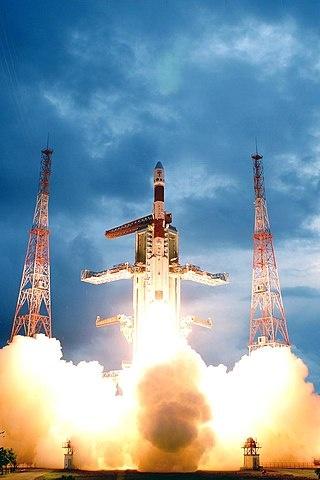
Chandrayaan-1 was launched on 22 October 2008 at 00:52 UTC from Satish Dhawan Space Centre using ISRO's 44.4-metre tall, four-stage PSLV-C11 launch vehicle. Rather than flying a direct trajectory, Chandrayaan-1 was sent to the Moon through a series of orbit-raising manoeuvres around the Earth over 21 days. At launch the spacecraft was inserted into a geostationary transfer orbit (GTO) with an apogee of 22,860 km and a perigee of 255 km. The apogee was increased with a series of five orbit burns conducted over 13 days.
Throughout the mission, ISRO's telemetry, tracking and command network (ISTRAC) at Peenya, Bangalore, tracked and controlled Chandrayaan-1.
Earth orbit burns
| Date (UTC) | Burn time | Resulting apogee |
|---|---|---|
| 22 October (launch) | 18.2 min (four stages) | 22,860 km |
| 23 October | 18 min | 37,900 km |
| 25 October | 16 min | 74,715 km |
| 26 October | 9.5 min | 164,600 km |
| 29 October | 3 min | 267,000 km |
| 4 November | 2.5 min | 380,000 km (lunar transfer) |
The second burn, on 25 October, took the spacecraft beyond the 36,000 km geostationary belt for the first time in an Indian mission. The fifth and final burn on 3–4 November placed Chandrayaan-1 on its lunar transfer trajectory with an apogee of about 380,000 km.
Lunar orbit insertion
Chandrayaan-1 completed lunar orbit insertion on 8 November 2008 at 11:21 UTC, firing its 440 N liquid engine for 817 seconds as it passed within 500 km of the Moon. With this operation, India became the fifth nation to put a spacecraft in lunar orbit.
| Date (UTC) | Burn time | Periselene | Aposelene |
|---|---|---|---|
| 8 November | 817 s | 504 km | 7,502 km |
| 9 November | 57 s | 200 km | 7,502 km |
| 10 November | 866 s | 187 km | 255 km |
| 11 November | 31 s | 101 km | 255 km |
| 12 November (final) | — | 100 km | 100 km |
On 12 November 2008 the spacecraft reached its mission-specific circular polar orbit of 100 km above the lunar surface. Two of the eleven payloads — the Terrain Mapping Camera (TMC) and the Radiation Dose Monitor (RADOM) — were switched on, and the TMC acquired images of both the Earth and the Moon.