Chandrayaan-2 Orbiter
Operational in lunar orbit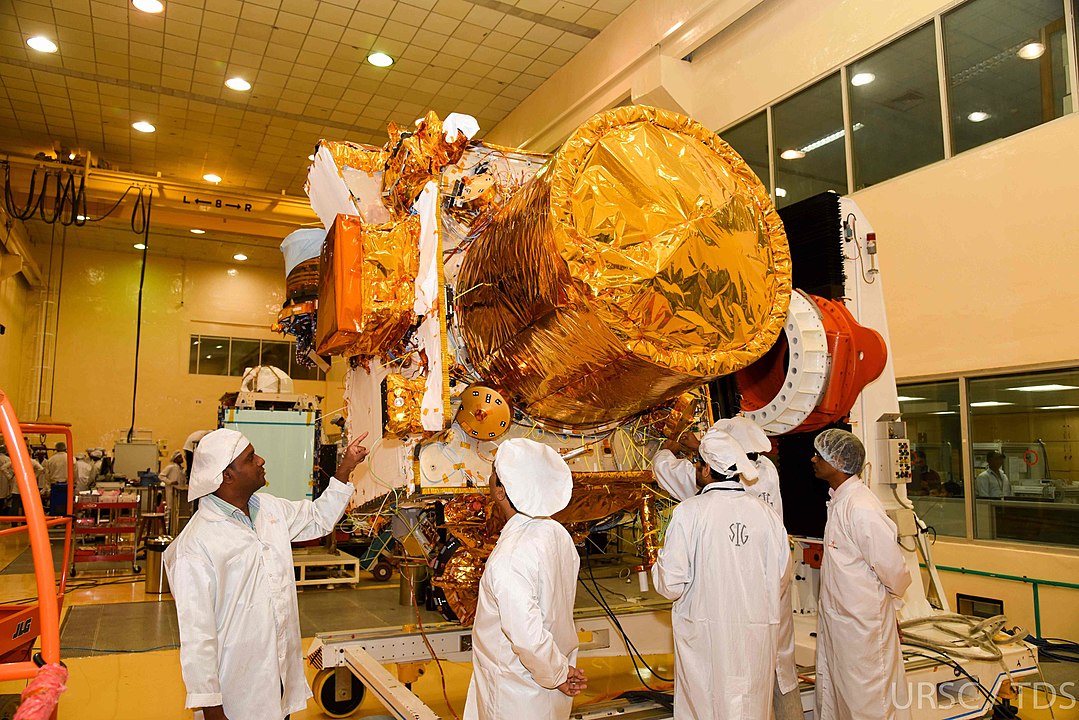
The 2,379 kg orbiter operates in a 100 km polar orbit around the Moon. Its precise launch left enough onboard fuel for about 7.5 years of operation, and it continues to return science data today. It also acts as a communications relay — a role it performed for the Chandrayaan-3 lander in 2023.
Instruments
- OHRC — Orbiter High Resolution Camera: the sharpest camera ever flown to the Moon (~25 cm resolution), used to scout landing sites.
- TMC-2 — Terrain Mapping Camera 2: 5 m resolution stereo topographic mapping.
- CLASS — Chandrayaan-2 Large Area Soft X-ray Spectrometer: global elemental mapping; produced the first global map of lunar sodium.
- XSM — Solar X-ray Monitor: measures solar X-rays supporting CLASS; also a sensitive solar-flare observatory.
- IIRS — Imaging IR Spectrometer: mineralogy and water/hydroxyl mapping in 0.8–5 µm.
- DFSAR — Dual Frequency (L & S band) Synthetic Aperture Radar: probes several metres below the surface; has reported signatures of possible subsurface water ice near the south pole, including a 2026 study identifying likely buried ice in four doubly-shadowed polar craters.
- CHACE-2 — Chandra's Atmospheric Composition Explorer 2: neutral mass spectrometer studying the lunar exosphere.
- DFRS — Dual Frequency Radio Science experiment: studies the lunar ionosphere.
Source: Wikipedia — Chandrayaan-2